
Welcome Center Mural — An inviting painted scene welcoming all who step through our doors to enjoy our rich history of Memorial United Methodist Church in Farmington, Missouri.
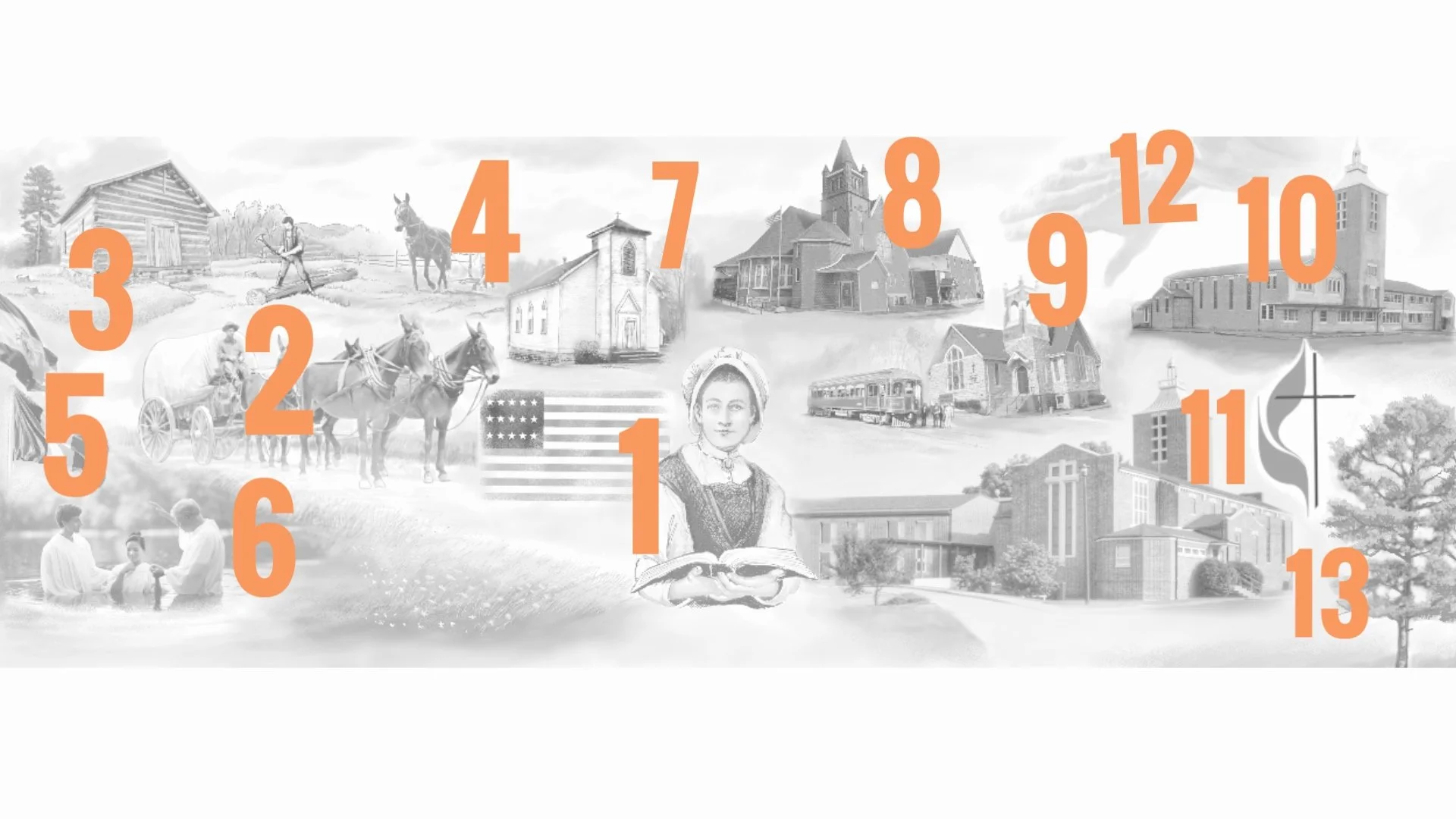
1 - Sarah Barton Murphy - A Woman of Faith, Courage and Determination-In the fall of 1798, Baptist preacher William Murphy, along with his sons David, William, and Joseph—sons from his first marriage—and Silas George, left their homes in eastern Tennessee in search of new land in the Louisiana Territory. When they arrived in Ste. Genevieve, they quickly discovered that French was the predominant language. They were directed to a gentleman who spoke English, who in turn found a local Osage Indian guide to accompany them. The men were searching for good farmland with an abundant supply of water. After traveling approximately twenty-five miles, they found a place that seemed perfect for their needs. At the time, the land was under Spanish control. To obtain a land grant, the settlers had to swear allegiance to Spain. Spain was also Catholic, and practicing any other religion was strictly forbidden. The men cleared the land, prepared it for farming, and planted crops. By 1799, their work was complete, and they began the journey back to Tennessee to collect their families and belongings. On the return trip, they stopped to visit another of William’s sons from his first marriage, John Fougouy. During the journey, William Murphy and Silas George became ill. Both died.
William’s sons continued to Tennessee and told their mother of their father’s death.
Sarah Barton Murphy now faced a decision that would define her legacy. Rather than abandon the dream she and her husband had shared, Sarah showed remarkable strength and determination. She told her sons to continue with their plans. She sent her youngest son, Richard, ahead to prepare the land William had claimed and begin planting crops so that the family would have a start when she arrived. Sarah settled her husband’s affairs, purchased a flatboat, and loaded it with her remaining belongings. She prepared for an arduous journey with her two youngest sons, Isaac and Jesse. Also accompanying her were one or two daughters, a grandson, William Evans, a freed Black woman and a boy, and a hired hand. They launched their flatboat onto the Holston River.
The journey would take them approximately 136 miles to the Tennessee River, another 652 miles to the Ohio River, and approximately 46 miles downstream to the confluence with the Mississippi. From there came the most difficult part of their journey. They had to travel up the Mississippi River, fighting strong currents and navigating rapids, logs, debris, unpredictable weather, and other dangers. Travel on the rivers during this period could be deadly. Boats were vulnerable to attacks by hostile Native Americans and bandits who preyed upon travelers. Some groups were forced to travel at night for protection. Between 1785 and 1805, it is estimated that more than 2,000 men, women, and children lost their lives traveling the waterways. Progress was slow. The passengers often had to paddle or pole the flatboat against the current. But Sarah Murphy and her family persevered. After traveling approximately 121 to 125 miles upstream on the Mississippi, they finally reached Ste. Genevieve. One can only imagine their gratitude after such an exhausting and dangerous journey. Yet their journey was not over. They still had approximately twenty-five miles overland before they could reach their new home and reunite with Richard and the others. On June 12, 1802, Sarah Barton Murphy finally set foot on the land that would become known as the Murphy Settlement—present-day Farmington. Because Sarah had wisely sent Richard ahead, she found that the corn he had planted was already growing—nearly knee-high. After the dangers and hardships, they had endured, one can only imagine the prayers of thanksgiving that rose from Sarah and her family as they finally arrived at their new home. But Sarah soon discovered another challenge. She was distressed to see the boys fishing and engaging in other activities on the Sabbath rather than observing the day as she believed they should. Church services were unavailable, and the settlers were becoming absorbed in the daily challenges of frontier life. Sarah was determined to change that. Although Spanish law still prohibited Protestant worship, Sarah quietly gathered people she trusted in her home for secret prayer meetings. She even posted sentinels to warn the group if Spanish officials or strangers approached. Sarah had already faced the dangers of an extraordinary journey. She was not about to allow Spanish law to keep her from worshipping God.
The First Protestant Prayer-In 1803, control of the territory changed hands. Spanish rule ended, followed briefly by French control, and then the territory became part of the United States. At last, the settlers could openly practice their religion. Sarah gathered the people of the settlement in her home so they could express their political and religious views and their desire to worship freely. Because of her courage and determination, Sarah Barton Murphy was honored with offering what is remembered as the first Protestant prayer openly west of the Mississippi River. Her influence did not stop there. Soon afterward, Sarah mounted her horse and rode throughout the settlement, asking parents to send their children to her home on Sundays. She kept the children throughout the day. They sang hymns, studied the Bible, learned to read and write, and were fed by Sarah. She is credited with establishing the first Sunday School west of the Mississippi River.
2 - Pioneer Wagon Immigrants - Missouri became known as the mule state during the 19th century because the area had more mules than anywhere else in the world. The mule was a cross between a male donkey and a female horse. The infertile offspring was intelligent, hardy and extremely strong as a draft animal to pull plows or wagons across the frontier.
By 1821 at the time of Missouri’s statehood, the mule industry had flourished, and Missouri became known as the gateway to the West for hundreds of thousands of pioneers headed across the Sante Fe Trail and Oregon Trail. The great gold rush of 1849 in California drew thousands of Americans headed West out of Missouri also. The mule as a draft animal was the best choice over oxen or horses, due to their hardiness in very harsh conditions and their consistent strength to pull heavy loads across rugged terrain, up mountains and across deserts. The mule will eat almost any sort of food and could survive when other draft animals could not. Since Missouri was a common starting point for the Westward migration, attaining your draft animals locally was most common. Many farmers became well known as mule producers in our area.
Locally in the 1800s mules were kept permanently underground in the Bonne Terre Mine before rail cars were implemented to haul out lead ore.
3 - Original Home / Church / Cabin of Pine Logs - Sarah eventually convinced her neighbors to build a log cabin near a small spring. There, she continued to organize and teach Sunday School. For children who could read, she used the Bible. For those who could not yet read, she used the Dilworth Speller. A large obelisk in the old Masonic Cemetery South, near present-day Henry Street in Farmington, bears this inscription: “On this spot the first Sunday School west of the Mississippi River was organized and taught by Sarah Barton Murphy in the year 1805 in the old log meeting house, which was the first Protestant church west of the Mississippi.” Although Sarah was a Baptist, the only preacher regularly available in the area was a Methodist itinerant minister, Rev. Oglesby. Sarah invited him to preach whenever he was able. When he was unavailable, Sarah conducted the services herself. Sarah Barton Murphy was a Christian willing to defy Spanish law to practice her faith. She was a wife, a mother, a friend, a teacher, and a missionary in a new and uncertain land. She was also a bold adventurer who had the courage to lead her family hundreds of miles through dangerous wilderness and waterways to build a new life. Her neighbors respected her intelligence, fairness, and wisdom. They often called upon her to settle disputes because they trusted her judgment. Sarah’s story is more than the story of a pioneer. It is the story of a woman who saw a need and refused to ignore it. She believed her family and her community needed faith, education, and a place to worship—and she took responsibility for providing them. Her determination helped establish the religious and educational foundation of the community that would become Farmington. More than two centuries later, Sarah Barton Murphy’s influence remains part of the history of Farmington and the story of Protestantism west of the Mississippi River. Her legacy can be summed up simply: She had faith enough to begin, courage enough to persevere, and determination enough to leave a lasting mark on generations to come.
4 - Clearing and Cultivating the Rich Land and Forests
5 - Flags of Spain, France, and Early Colonial U.S. 1800 - 15 States (Missouri was the 21st added in 1821)
6 - Early Methodist Movement 1830s Camp Revivals and Baptisms in Wolf Creek.
7 - Earliest Church for the Methodists in Farmington - At the corner of South Jefferson and Second Streets once stood a frame building which served as the center of activity for Farmington’s Black Community. Built in 1857 as the Good Will Lodge for the Brotherhood of Black Knights of Pythias, the building later became home to St. Luke’s Colored Methodist Episcopal Church (CME), followed by St. Paul’s AfricanMethodist Episcopal Church (AME). St. Paul’s AME remained at this site until 1877, when a new building was erected on South Franklin and Third Streets, the building depicted in the mural. At that time, the church was pastored by Reverend Christopher Tayes. Documented historically as the oldest church organized for black congregants in St. Francois Countyand named in honor of the Apostle Paul, St, Paul’s AME Churchserved as a vital spiritual and social cornerstone for the AfricanAmerican Community in the Farmington and Southeast Missouri Region during the Post Reconstruction Era. It merged with Memorial United Methodist Church in 1965.St.
8 - South Methodist Church in Farmington - M.E. Church South (Murphy, Long Memorial) Church of Farmington, Missouri. Around 1844, the Methodist Episcopal Church split into two factions over the issue of slavery, creating the M.E. North and the M.E. South congregations located just a few city blocks apart from each other. At the advent of the Civil War, the M.E. South Church fell into a period of lethargy and hardship, likely caused by the turmoil of war and a decline in membership. The church experienced a revival in 1876 under the leadership of the newly arrived Reverend J. H. Headle, when the congregation numbered approximately 27 devoted members. In 1881 the first building was erected at the corner of West Columbia and Clay Street in Farmington; that original structure was later raised to make way for a larger, more substantial edifice in 1902. The present brick structure on the site was constructed at a cost of $25,000 and stands as a fine example of the federal style of church architecture. On September 25, 1927, the congregation formally renamed the church the Murphy Long Memorial Church, dedicating it to the memory of Mrs. Sarah Barton Murphy and her grandchildren Dubart Long and Jeannie A. Long Bisby. The large stained-glass windows on the north side of the church were donated by W.D. Long, and the interior was graced by a substantial pipe organ given in 1909 by Jane Bisby, daughter of Isabella Long. In the 1950s, with the formation of Memorial United Methodist Church, ownership of the property passed to the Farmington Christian Church; today the building is recognized as the Free Will Baptist Church located on the block of Columbia, Clay Street, and N. A Street in Farmington. The (#8 Top) picture in the mural reflects the church’s appearance before later additions were made.
9 - North Methodist Church in Farmington - As more settlers arrived, the Methodist Episcopal Church was formed in 1820 and continued to grow until the division that brought on the Civil War in the nation also caused a split in the congregation. After the war, the church was reorganized as the Methodist Episcopal Church and M. E. Church, South. The Methodist Episcopal Church, North which had been inactive since 1844, revived after the war, chiefly through the leadership of Miss Eliza A. Carleton. She was a well-educated, devout woman who established Carleton Institute north of town. In response to her call, three ministers came and organized a Farmington circuit, including all of St. Francois and Ste. Genevieve counties and parts of Jefferson, Washington, Iron, and Madison counties. In 1878 Farmington was made a charge. This group purchased a large brick building at Harrison and South Henry, from the Christian Church which had become inactive during the war. Services were held on the second floor, and the resident minister and his family lived on the first floor. This church was strengthened by the presence of Carleton College, which now had moved to Farmington. As this congregation grew; a new site was purchased at the corner of West Columbia and Franklin Streets. A building of native limestone erected here in 1904 and was often called the Rock Church. (This is now occupied by the Farmington Christian Church) The church is built in a Gothic Revival style. As population moved toward Farmington, and transportation became easier, small churches joined with larger ones. The Copenhagen Church, originally German speaking, became part of the M. E. (Rock) church in 1917. The church growth was paralleled by the general growth of the town. In about 1937, the M. E. Church, North, memorialized Miss Carleton, calling it Carleton Memorial Church. In 1939, the Methodist Episcopal, Methodist Episcopal, South, and the Protestant Methodist Churches voted to unite nationally and worldwide. In 1950 the two local Methodist churches voted for unification. Members of Delassus joined the merged Methodists about 1950. In 1960 Salem Church, north of town, joined the larger church, and then St. Paul’s AME congregation followed in 1965.
10 - Memorial United Methodist Church - 1957
11 - Memorial United Methodist Church to Present - In 1950, the Carleton Memorial and Murphy-Long United Methodist churches began new talks of merging the two congregations, both of Farmington, MO. The congregations had first voted on the merger in 1944. It had passed the vote at Murphy-Long at the time but failed in the Carleton church. During the intervening years, the two congregations had grown more interested in combining forces. They had come to hold combined Sunday evening services and worked increasingly together in other matters. The two churches, each with debt-free buildings and parsonages, each took a vote of all members 21 years of age or older at Noon on January 1, 1950, and both churches overwhelmingly voted for the merger. Rev. Elbert Cole, who had recently moved to Farmington, was the pastor of both churches at the time of the merger and stayed an additional five years as pastor of the combined congregation. A building committee was put forth and came up for a budget of $240,000 for building the sanctuary, tower, and educational building. After diligent planning, fundraising and lots of hard work, the building was completed and dedicated to God at a service on June 9, 1957. In 1962, the fellowship hall, kitchen, parlor and scout basement – collectively called “The Parish House” were completed. The current parsonage – next door to the church -- was dedicated in 1979. In 1998, a new addition was conceived and began construction, which completes the current physical plant of the facility. In that addition, a new classroom and office area was added, including the youth basement.
As fine as the buildings are, however, the buildings are not the church. As Eugene D Denman puts it in his Brief History of Memorial United Methodist Church, “the church is made of up people who gather to worship and go forth to serve the community locally and the world in mission. As we serve, so will we grow and share our faith. To carry out this purpose, we have programs to suit many needs.” It is all to the glory of God. Through many decades of solid lay and clergy leadership, this church has made disciples of Jesus Christ for the transformation of the world, baptized in the name of the Father, the Son and the Holy Spirit, taught all Jesus commanded and known He is with us now and forever. All glory and praise to God!
Pastors Serving Memorial UMC
*Elbert Cole 1950-1955
*Carl Bergsten 1955-1957
*Joseph Jones 1958-1962
*W. Cannon Kinnard 1963-1970
*Maxwell Teeter 1970-1982
*Dick Detweiler 1982-1987
Jim Powell 1987-1993
David Webster 1993-2006
Rick Broadway 2006-2012
*Scott Hall 2012-2019
Ron Beaton 2019-2024
Christopher Reyes (Associate Pastor) 2022-Present
Shannon Davis (Senior Pastor) 2024-Present
Kristine Klein (Associate Pastor) 2026-Present
12 - God Continues to Bless and Guide this Community
13 - Shortleaf (Native) Pine Forest in this Area Prior to 1800
Paul's church in Farmington, Missouri, was organized in 1877 by Reverend Christopher Tayes as the St. Paul Methodist Episcopal Church. It was located on the corner of South Franklin and Third Streets and faced west. Documented historically as the oldest church organized for Black congregants in St. Francois County. It was named in honor of the Apostle Paul. St. Paul’s ME Church served as a vital spiritual and social cornerstone for the African American community in the Farmington and Southeast Missouri region during the post-Reconstruction era. It merged with Memorial in 1965.
Quisque iaculis facilisis lacinia. Mauris euismod pellentesque tellus sit amet mollis.